Why Sourcing in the Lower Middle Market Is Harder Than It's Ever Been
"The old private equity playbook depended on cheap debt, multiple expansion, and the idea that financial engineering alone could drive returns. In 2026, all three tailwinds are gone. The only edge left is getting to the right deal before anyone else does."
— Bain & Company, Global Private Equity Report 2026
Introduction:
The lower middle market looks the same from the outside. Fragmented industries. Founder-led businesses. Patient capital. Long relationships. But underneath the surface, something has quietly shifted over the last decade, and most firms are still running the same sourcing playbook they used when the environment was completely different.
The competition for quality deals has become the most intense it has ever been. The data makes this hard to ignore. And yet, the firms responding to that reality are still a small minority. Here's what the numbers actually show, and what it means for how serious acquirers are building their sourcing infrastructure today.
1. The Numbers Don't Lie
According to Bain & Company's 2026 Global Private Equity Report, global buyout deal value hit $904 billion last year, the second-highest figure ever recorded. That sounds like a thriving market. But the story underneath that number tells a different one.
Deal count actually fell 6% to 3,018 transactions. The average deal size hit an all-time record of $1.2 billion. Thirteen megadeals alone, each over $10 billion, contributed 69% of total deal value growth. The market is concentrating at the top.
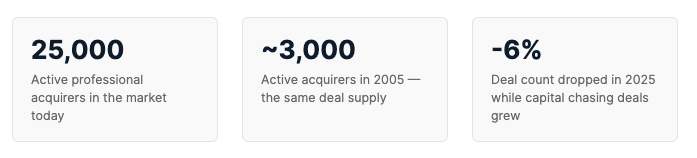
The buyer pool has grown by more than 8x in two decades. The supply of quality lower middle market businesses available to acquire has not. More capital, more competition, fewer deals. The math is not in your favor if you're running the same process everyone else is running.
2. The Old Playbook Is Getting More Expensive
For most of the last decade, private equity returns were driven by three factors: cheap debt, rising multiples, and operational leverage. All three have compressed simultaneously.
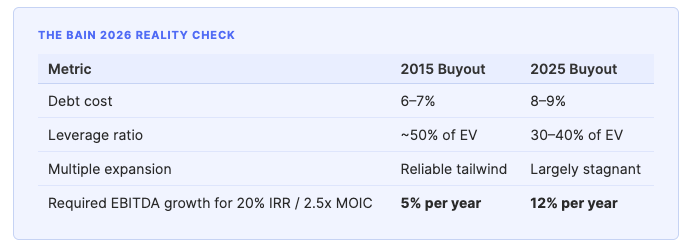
Financial engineering is no longer a return driver. To hit the same return target, a firm needs to grow EBITDA at more than twice the rate it did a decade ago. That changes everything about how entry price and deal quality need to be managed. You can no longer overpay for a deal and expect the market to bail you out at exit.
Getting to the right deal at the right price, before a competitive process inflates it, has never mattered more.
3. The Channels Everyone Is Using Are Getting Crowded
The sourcing playbook most firms still rely on was built for a different environment. Broker processes. Cold outreach. Database platforms. Referral networks. Each of these channels has its role, but each is also facing structural headwinds that are getting harder to ignore.
Cold email response rates have dropped by more than 50% over the last two years. The inbox is more crowded than it has ever been, and the owners who are most worth talking to are also the most contacted. Every firm running an outbound campaign is pulling from the same data sources, writing to the same owners, and arriving in the same inbox.
Brokered processes solve the access problem but create a different one. By definition, when a deal enters a formal process, you're no longer the only buyer at the table. The seller has representation. Expectations are anchored. The window for early relationship-building is closed.
The firms outperforming on deal sourcing aren't abandoning these channels. They're asking a harder question: where is the inventory that none of these channels can reach?
4. Where the Real Inventory Actually Is
The businesses that appear in a brokered process, a PitchBook alert, or a database export represent a fraction of what is actually acquirable in the lower middle market. Research consistently shows that the majority of lower middle market business owners are open to a conversation about a sale, but they haven't listed, haven't engaged a broker, and won't appear in any traditional sourcing channel.
These owners are not invisible because they don't want to sell. They're invisible because no formal process exists yet. They're researching. They're thinking about it. They're at the stage where a trusted conversation, before advisors are involved and before expectations are anchored, is still possible.
This is the segment of the market that competitive sourcing infrastructure is designed to reach. Not owners who have already decided to run a process. Owners who are just beginning to explore what that process might look like, and who haven't talked to anyone yet.
5. What Proprietary Deal Flow Actually Looks Like
The conversation that happens before a process starts is a fundamentally different conversation. No advisor managing the information flow. No competing bids setting a pricing floor. No anchored expectations from a CIM that was sent to thirty buyers simultaneously.
An owner in that window is talking to you because they chose to. The dynamic of that conversation, the flexibility on structure, the speed to LOI, and the quality of information shared are incomparable to what happens after a process is formally underway.
One acquirer focused on transportation and fleet businesses, generated 39 owner-initiated conversations in 60 days through inbound origination channels. Another running multi-site service acquisitions had 2 LOIs signed inside the same window from 24 owner-initiated introductions. In both cases, the owners reached out before any advisor was involved. No auction. No competing bids. Just a conversation at the right moment.
6. What This Means for How You Source in 2026
No single sourcing channel is sufficient. Broker relationships surface deals that are ready to transact. Referral networks build trust in specific communities. Databases and outbound campaigns reach owners at scale. These channels all have a place in a complete sourcing stack.
The gap most firms have is at the earliest stage of the funnel. Owner-initiated conversations before any process exists. This is the hardest stage to access through traditional methods and the highest-value stage to be present at. The firms closing more deals at better terms in this environment are not finding better brokers or better databases. They are building infrastructure to access owners before those channels even enter the picture.
That infrastructure is not a new idea. It's just not widely built yet. The firms doing it quietly are accessing a part of the market that their competition cannot see. That gap will not stay open indefinitely.
If you're thinking about what inbound origination infrastructure looks like for your firm's specific mandate and sectors, that conversation is worth having sooner rather than later. Get in touch with Stratus Holdings.